

Drop 20 PDFs · get a 30-page review with real citations

The Agent reads each paper, fans out via Deep Research to find the references you didn't include but should have, draws the citation graph, and writes a literature review with inline references — every claim traceable to a real DOI. A BibTeX file ships alongside so you paste straight into Overleaf.

A peek at what you get

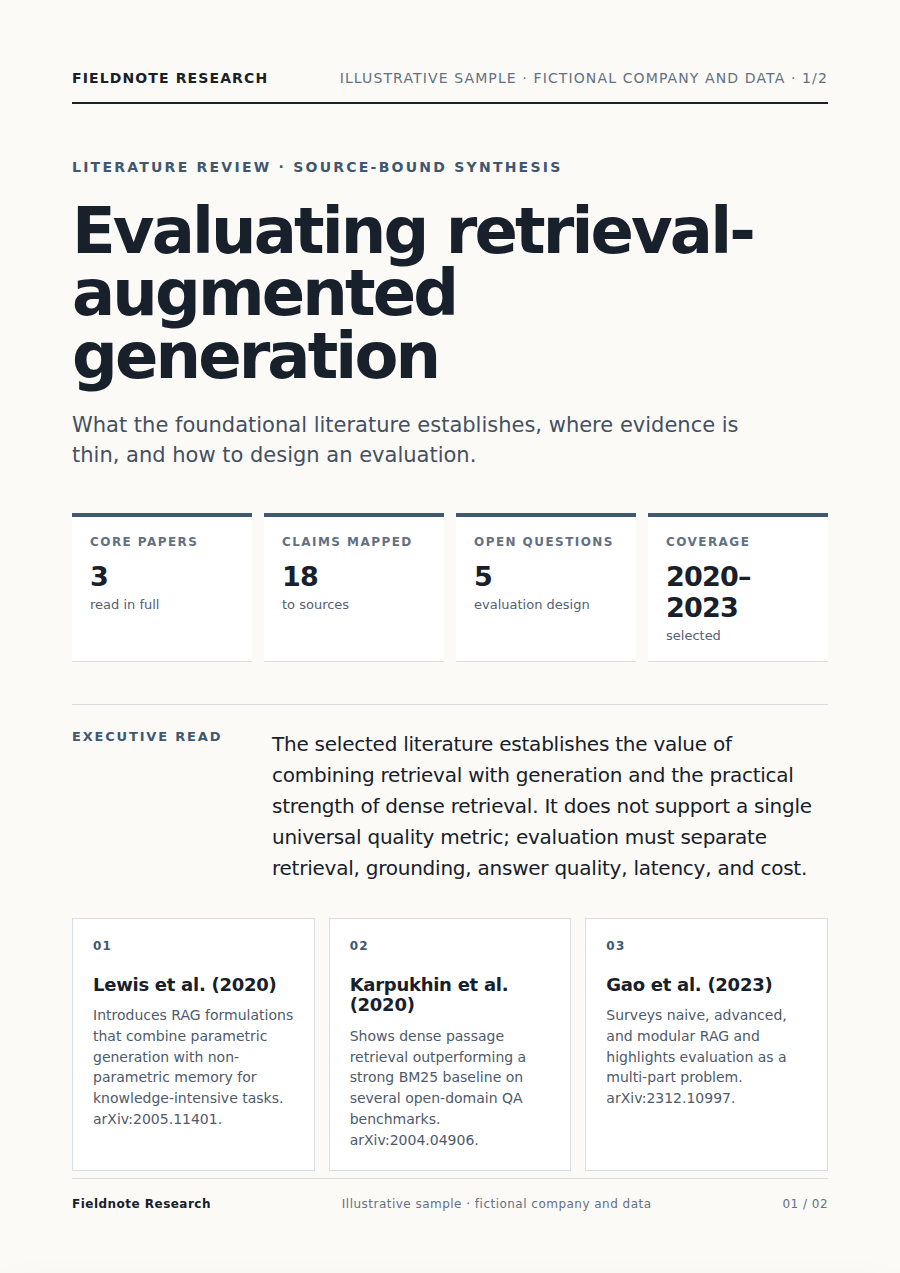
Cover + abstract
Page 1 of 4·Cover + abstract
Citation graph
Page 2 of 4·Citation graph
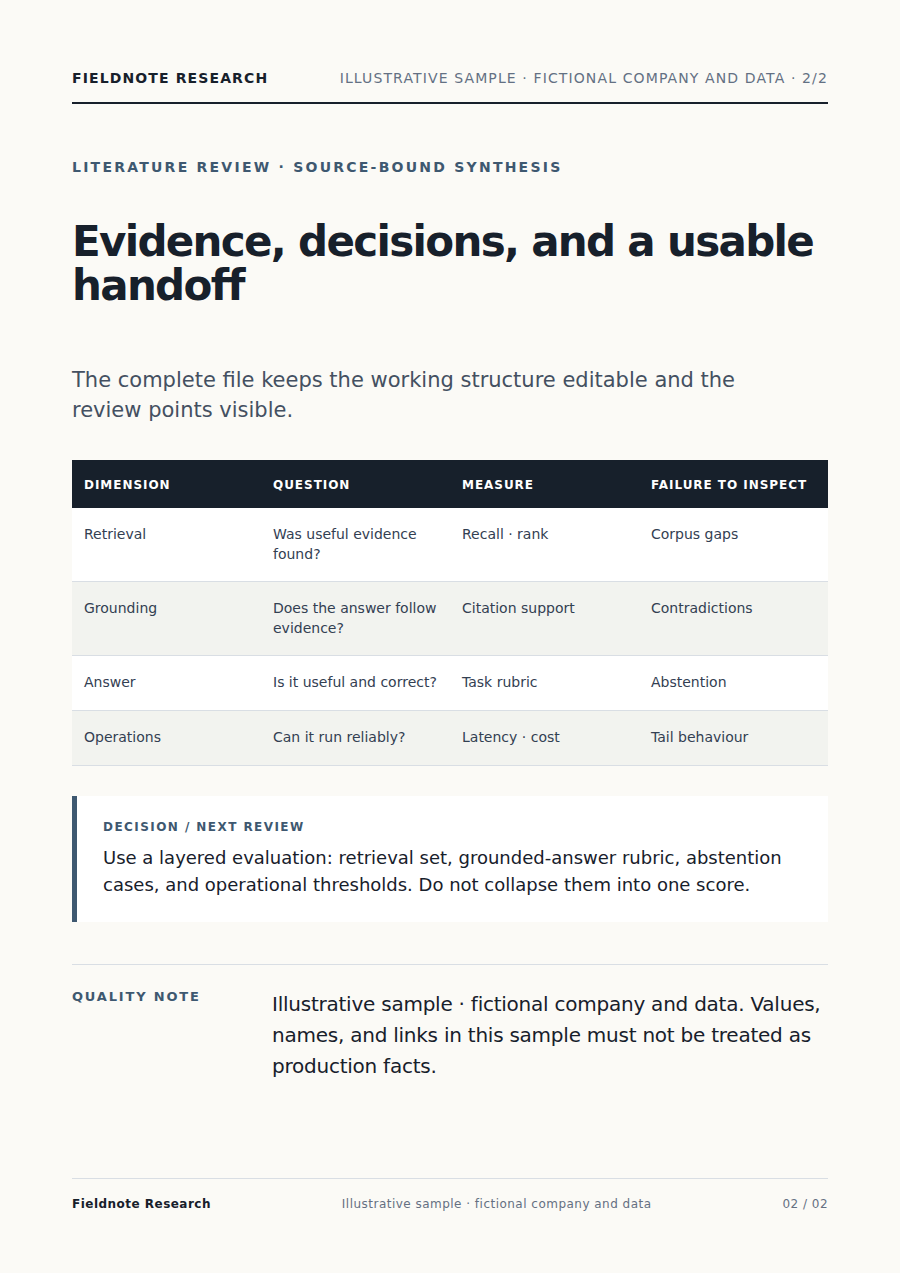
Thematic synthesis
Page 3 of 4·Thematic synthesis
References
Page 4 of 4·References

Citation graph · what you brought + what Deep Research found

Navy nodes are the 22 PDFs you uploaded. Gold nodes are papers Deep Research surfaced by tracing citations two levels forward and back. You vote on each gold node before it enters the review.

Hamilton 2018He 2020Kipf 2017
Your input · 22Added via Deep Research · 13Rejected on your vote · 2
parse_pdf22 papers · pdfplumber + markitdown
deep_researchforward+backward · 2 hops · 13 candidates
render_reviewweasyprint · APA 7 · biblatex

Every claim cites a real paper · here are three

No hallucinated authors. Each excerpt below corresponds to a paragraph in the review and links back to a DOI.

Theme 1 · Inductive simplification of GNN layers
Removing the feature transformation and nonlinearity in GCN does not hurt recommendation accuracy and substantially improves training efficiency.
He et al., 2020 · SIGIR·doi:10.1145/3397271.3401063
Theme 3 · Item-item collaborative signal in graph form
High-order connectivity in the user–item bipartite graph carries collaborative signal that classical embedding methods do not capture.
Wang et al., 2019 · KDD·doi:10.1145/3292500.3330989
Theme 5 · Are heavy GNNs necessary at all?
On standard benchmarks a properly tuned MF baseline closes most of the gap to graph-based methods, suggesting much of the reported improvement comes from training tricks rather than the graph itself.
Mao et al., 2021 · CIKM·doi:10.1145/3459637.3482008
literature-review.pdf
32 pages · APA 7
references.bib
35 entries
citation-graph.svg
paths + labels

How it works

Step 01

Drop the papers you have

Individual PDFs, a zip, or an existing .bib file the Agent should expand from. 20–80 papers is the sweet spot. The Agent reads each fully — not just abstracts — and keeps track of what was found where.

Step 02

Pick the review style

Systematic review for a journal submission? Narrative review for a thesis opening? Structured data extraction for a meta-analysis? Each path follows different community norms — the Agent enforces them so reviewers don't bounce your draft.

Step 03

Pick up the review + bibliography

The review PDF lands in your Drive with every cited paper resolved to a real DOI. The .bib is in the canonical form Overleaf and Zotero expect. A citation graph as SVG shows the network the Agent traversed; any new paper it added beyond your input set is highlighted so you can vote it in or out.

Why Vecbase for this

Every citation is a real DOI — no hallucinated "Smith et al. 2017"

Generic chatbots invent plausible-sounding citations because they're trained to produce coherent text. The Agent only cites papers it has either read (your PDFs) or fetched a real metadata record for via Deep Research. If a claim cannot be backed by a real paper, the Agent says so in chat — it does not invent a source.

It finds the papers you didn't know to include

The Agent traces citations forward (who cited these later?) and backward (what did these build on?) two levels, plus scans 4–6 relevant venues for missed work. You get a "candidates" list to vote on before they enter the review — you stay in control, but the corpus is no longer just what your advisor remembered to send you.

Real PDF parsing in the sandbox — equations and tables survive

Cheap "AI summarizer" tools strip PDFs to plain text and lose all the equations and tables that contain the actual results. The Agent parses with `pdfplumber` and `markitdown` in the sandbox, plus `camelot-py` for table extraction — equations and structured rows survive. The review can quote the actual reported effect size, not just "the authors found a positive effect".

A citation graph you can argue with

The Agent ships an SVG of the citation network it traversed: nodes are papers, edges are citations, color indicates whether the paper was in your original set or added later. You can ask in chat "why did you drop this branch" or "add the 2024 papers in the bottom-right cluster" and the review regenerates with that change.

Frequently asked

Comfortably 20–80 papers in one pass. Beyond ~100, the Agent will suggest splitting the corpus into thematic batches and writing the review chapter-by-chapter — you still get a coherent final document, but the corpus management stays sane. The hard cap is set by sandbox storage (200 MB of PDFs ≈ ~150 typical papers).

Get yours in under 90 seconds

Sign in, hand it over to the Agent — the finished file lands in your Drive.